
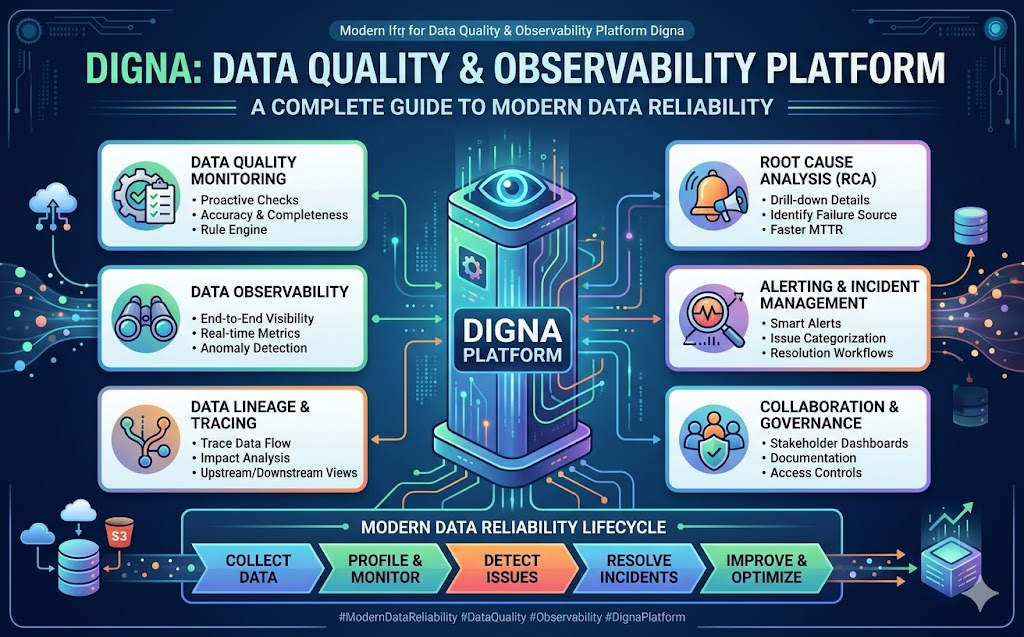
In today’s data-driven world, organizations depend heavily on accurate, consistent, and real-time data to make critical business decisions. As data ecosystems grow more complex, ensuring data reliability becomes increasingly challenging. This is where a Data Quality & Observability Platform digna plays a vital role, helping businesses monitor, validate, and trust their data at every stage of its lifecycle.
A modern Data Quality & Observability Platform digna is designed to give teams full visibility into their data pipelines, detect anomalies early, and maintain high standards of data integrity across systems. It acts as a central layer of trust between raw data sources and business intelligence tools.
What is Data Quality & Observability Platform digna?
A Data Quality & Observability Platform digna is a specialized solution that continuously monitors data pipelines, datasets, and data transformations to ensure accuracy, completeness, consistency, and reliability.
Unlike traditional data quality tools that only perform batch validation, digna-style observability platforms focus on real-time monitoring and proactive issue detection. They help organizations answer key questions like:
- Is my data accurate right now?
- Did any pipeline break or produce incorrect values?
- Where did the data issue originate?
- How quickly can I fix it?
By answering these questions, a Data Quality & Observability Platform digna ensures that data teams are not reacting to problems after they impact the business but are instead preventing them before they occur.
Why Businesses Need Data Quality & Observability Platform digna
As organizations scale, they often face data challenges such as missing values, duplicate records, schema changes, and broken pipelines. These issues can lead to incorrect reporting, poor decision-making, and financial loss.
A Data Quality & Observability Platform digna helps solve these challenges by offering:
1. Early Detection of Data Issues
Instead of discovering problems in dashboards or reports, the platform detects anomalies as soon as they occur in the pipeline.
2. End-to-End Pipeline Visibility
It provides a clear view of how data moves from source systems to analytics tools.
3. Faster Incident Resolution
With root-cause analysis features, teams can quickly identify where and why data issues occurred.
4. Improved Trust in Data
When stakeholders trust the data, they make better strategic decisions.
Core Features of Data Quality & Observability Platform digna
A modern digna Python SDK Release typically includes several powerful features designed for enterprise-scale data management.
Data Validation and Quality Checks
It continuously checks for schema mismatches, missing values, and unexpected changes in datasets.
Real-Time Monitoring
The platform tracks data pipelines in real time, ensuring that any failure or anomaly is immediately flagged.
Lineage Tracking
Data lineage helps users understand where the data originated and how it has transformed over time.
Alerting and Notifications
Users receive instant alerts when data quality issues are detected, allowing quick response.
Anomaly Detection
Machine learning models often help detect unusual patterns in data automatically.
Dashboard and Visualization
A centralized dashboard gives teams visibility into all data health metrics in one place.
How Data Quality & Observability Platform digna Works
The Data Quality & Observability Platform digna operates by integrating directly with data pipelines, warehouses, and transformation tools.
Here’s a simplified workflow:
- Data Ingestion
Data enters from multiple sources such as databases, APIs, or streaming platforms. - Monitoring Layer Activation
The platform continuously monitors incoming data for quality metrics. - Validation Rules Execution
Predefined or dynamic rules are applied to ensure data correctness. - Anomaly Detection
Any unusual pattern or failure is flagged immediately. - Alert Generation
Alerts are sent to data engineers or analysts. - Root Cause Analysis
The system helps trace the issue back to its origin. - Resolution and Recovery
Teams fix the issue and restore data accuracy.
Benefits of Using Data Quality & Observability Platform digna
Implementing a Data Quality & Observability Platform digna offers several advantages for organizations of all sizes.
Improved Decision-Making
High-quality data leads to better insights and smarter business strategies.
Reduced Operational Costs
Early detection reduces downtime and prevents costly data errors.
Increased Efficiency
Automated monitoring reduces manual data checks.
Stronger Data Governance
Ensures compliance with internal and external data standards.
Scalability
The platform supports growing data ecosystems without compromising reliability.
Use Cases of Data Quality & Observability Platform digna
The Data Quality & Observability Platform digna can be applied across various industries and scenarios:
E-commerce
Ensures product, pricing, and inventory data accuracy in real time.
Finance
Helps maintain accurate transaction data and regulatory compliance.
Healthcare
Ensures patient records and clinical data are correct and up-to-date.
SaaS Platforms
Monitors user activity data and system logs for consistency.
Marketing Analytics
Validates campaign data and attribution metrics for better ROI tracking.
Challenges Solved by Data Quality & Observability Platform digna
Before such platforms, organizations often struggled with:
- Late detection of data errors
- Lack of pipeline transparency
- Manual debugging processes
- Inconsistent data across systems
- Poor data trust among teams
A Data Quality & Observability Platformd digna directly addresses these issues by centralizing monitoring and automating detection mechanisms.
Future of Data Quality & Observability Platform digna
The future of data observability is moving toward deeper automation, AI-driven insights, and predictive data quality management.
A next-generation Data Quality & Observability Platform digna is expected to:
- Predict data failures before they happen
- Automate data healing processes
- Integrate deeply with AI analytics systems
- Provide self-service debugging tools
- Offer real-time governance at scale
As data continues to grow exponentially, such platforms will become essential infrastructure for every data-driven organization.
Conclusion
A Data Quality & Observability Platform digna is no longer just a nice-to-have tool—it is a critical component of modern data infrastructure. By ensuring accuracy, transparency, and reliability across data pipelines, it empowers organizations to make confident, data-driven decisions.
From real-time monitoring to anomaly detection and root-cause analysis, this platform strengthens the foundation of any analytics ecosystem. As businesses continue to rely more heavily on data, adopting a Data Quality & Observability Platform digna will be key to maintaining competitive advantage and operational excellence.







Leave a Reply